

Same Power, More Compute
How Fluidstack’s Demand Management system lets us deploy more compute with the same power.
This is the first post in a series on Fluidstack’s Demand Management system. It covers what power oversubscription is and why it matters.
To deploy more compute, you typically need more power. Today, power is getting increasingly hard to come by. So how can we deploy more compute with the power we already have? This is the question Fluidstack’s Demand Management system seeks to answer.
What is power oversubscription?
Power oversubscription refers to installing hardware whose combined peak power draw exceeds the available capacity.
Consider a site with 30 megawatts available to power IT equipment. Conventional design would cap installed peak capacity at 30 megawatts, as it assumes that every accelerator could draw its peak power at once.
Let’s say instead that we were to deploy 40 megawatts of peak IT capacity. If all IT equipment were to peak simultaneously, power consumption would exceed the available 30 megawatts, risking trips of protective breakers.
In practice, however, different AI workloads have different power profiles. That means that the power consumption of a cluster running a mix of workloads will fluctuate as workloads move through different phases – for example, inference power consumption rises and falls with traffic, while training power consumption varies depending on phase.
The facility must support the fleet’s actual demand at every moment, which is typically lower than the sum of every device’s peak power draw. When these peaks do coincide, the system must be able to throttle workload power consumption to ensure the facility’s limits are not breached.
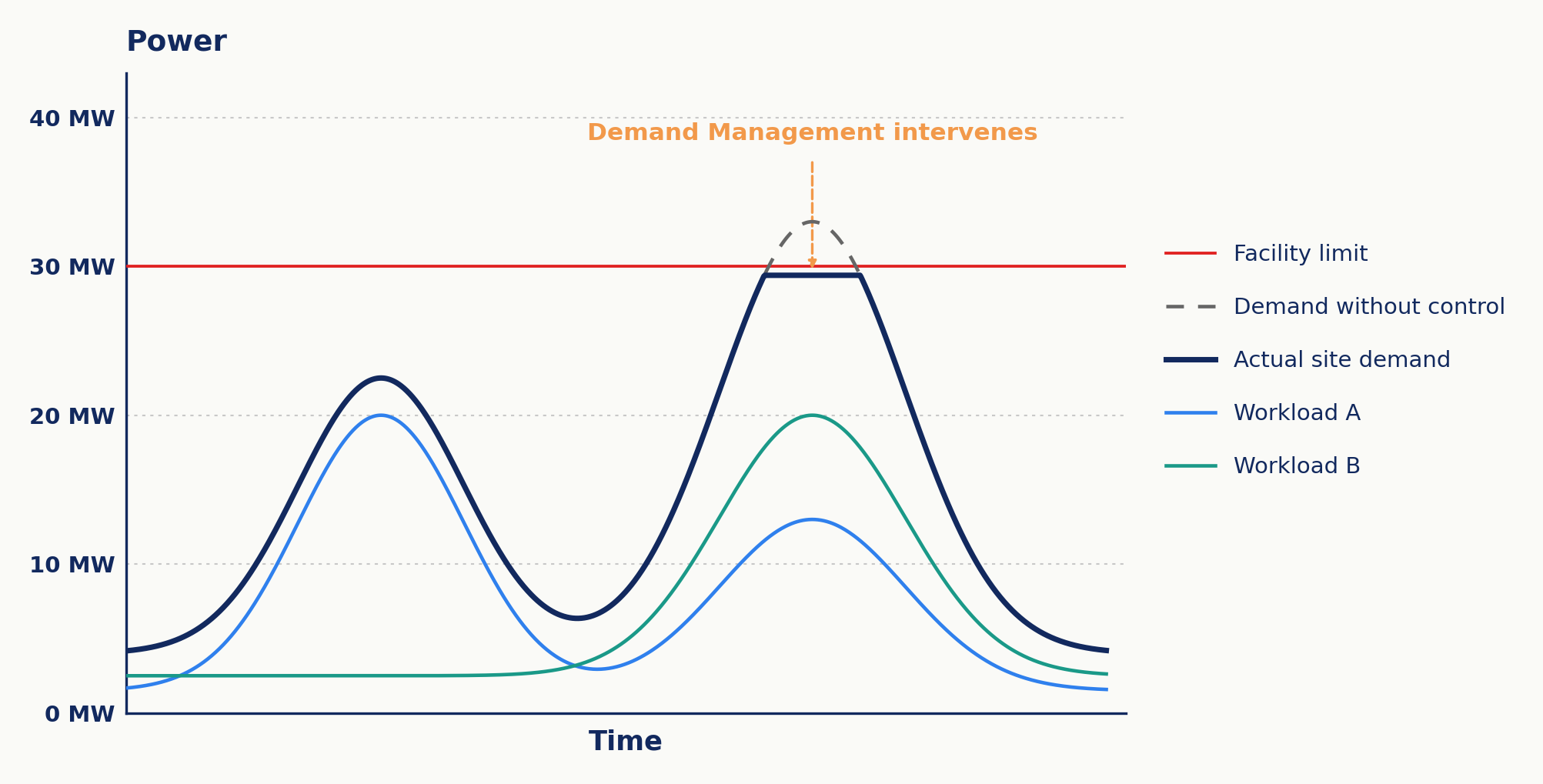
The importance of reliability and controllability
Oversubscription means the site now operates closer to the facility’s protective limits. If telemetry is wrong or control reacts too slowly, protective breakers may trip and take equipment offline – the system must act before protection does. Fluidstack’s Demand Management system ensures this by continuously measuring facility telemetry and actively controlling demand when thresholds are about to be breached.
The facility needs an accurate and reliable understanding of current power and cooling limits that its active equipment can support. These limits can change – for example, during transfers to backup generation, cooling system failures, or maintenance operations. The system must compare aggregate demand against the current boundary and act before it crosses it. If telemetry or control becomes unavailable, the system must also fall back to a known safe operating limit.
The solution crosses the facility boundary
Demand Management depends on:
-
Electrical and cooling infrastructure adequately sized for the intended deployment.
-
Fresh, reliable, and granular telemetry on current power and thermal conditions, equipment state, and alarms.
-
An accurate, live topology model that connects each load to the upstream power and cooling infrastructure serving it and shows how these domains overlap.
Together, these pillars help us observe the facility, identify active constraints, calculate new safe limits, communicate them to the scheduler, and verify that demand has changed.
Making intelligence abundant involves both adding new power generation and making better use of existing capacity. Demand Management allows Fluidstack to deploy a larger fleet by using otherwise unused capacity.
The next two posts explain the underlying telemetry and topology systems that enable this.